Time, Travel and Transition...Overcoming Daily Challenges with Visual Strategies.
Presented by Linda Hodgdon, M.Ed, CCC-SLP.
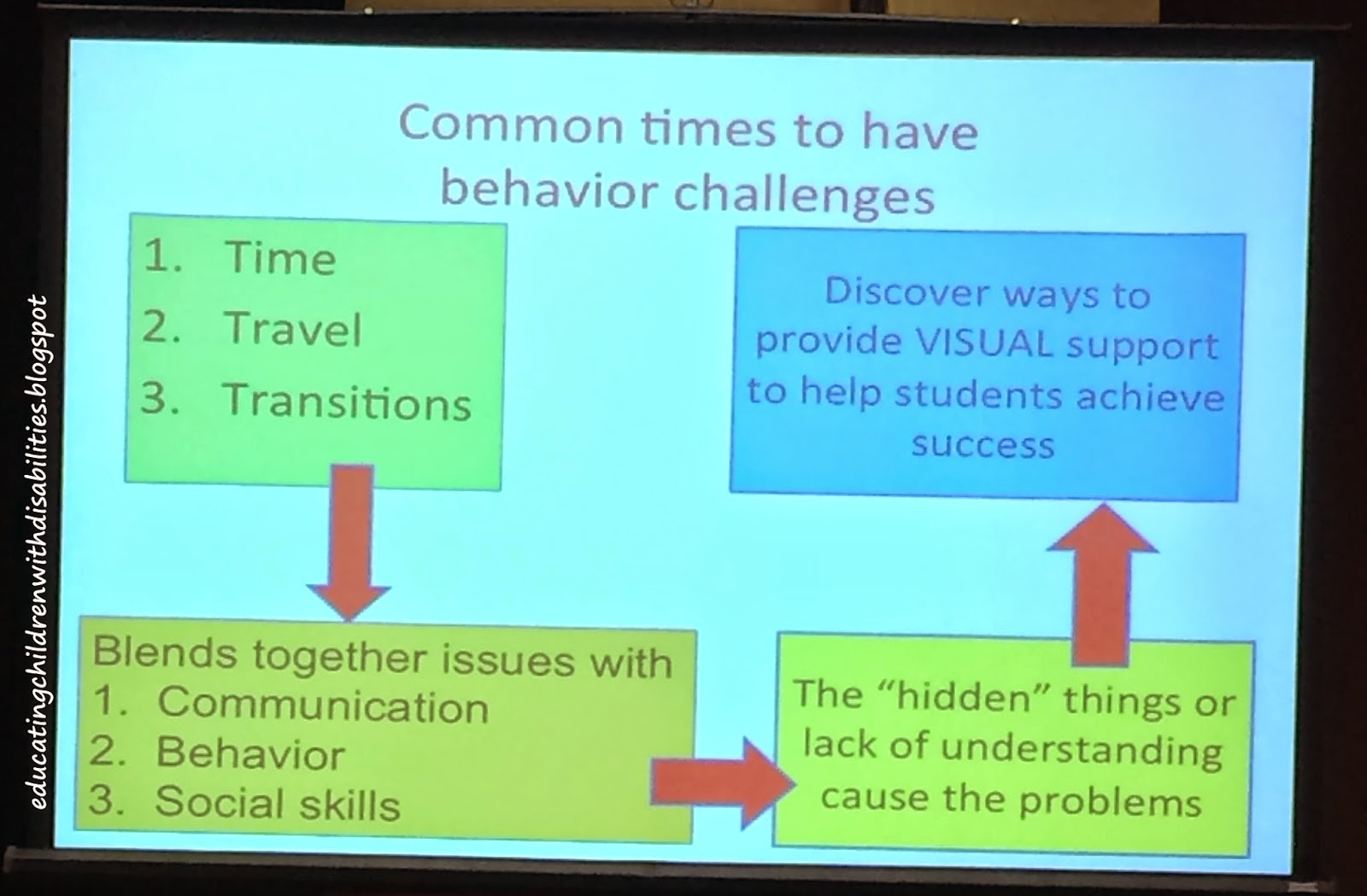
A primary part of ASD includes challenges in communication skills:
expression and understanding
Visual Strategies can accomplish many purposes:
get attention
clarify
aid memory
making choices
aid decisions
organize thinking
There are a wide range of visual supports...Low tech (paper) to High tech (electronic devices).
Goals
1. Avoid unexpected surprises: provide information, don't assume they understand, they have difficulty generalizing information.
2. Give lots of information: Social stories give information of what is going to happen and what you will be doing.
Time is invisible! Manage it visually with timers, visual count down, take turn visuals, and visuals to show when they can do it again.
Organization tip: Have a binder for each student with their social stories. They can reread them anytime.
Travel
Travel is unpredictable with lots of changes! Moving from one side of a room to another, room to room, a strange house, going shopping, riding in an unfamiliar car, airports (!)
Who will we see? Visiting family members you don't see often? Take lots of pictures of the people and places.
Break up the stories, for example when flying....going through security...is a story by itself.
Sequence the transition and help him or her understand the WHY.
Once again....Videos are HUGE. Make video your friend and editing the videos is crucial.
They can be used for social stories.....
create them for a purpose....how to greet people...open gifts....how to play....transition from elementary school to middle school (walk through the new school talking about it).
These are my notes from Ms. Hodgdon's presentation. There is much much more information!
I hope this has given you some ideas!
Later,
Paula
Creating a learning environment for children with multiple disabilities.
Showing posts with label Linda Hodgdon. Show all posts
Saturday, February 28, 2015
Monday, February 23, 2015
2015 Special Education Conference: Linda Hodgdon, Visual Strategies Part 1
Our keynote speaker on the first day of the conference was Linda Hodgdon.
Her presentation..........
Linda Hodgdon, M.Ed, CCC-SLP is known as a pioneer in developing the use of visual strategies to support communication for students with Autism. She is an author, a speaker and a consultant.
The first point that Ms. Hodgdon made was that our way of using visuals has made some big changes. We have come from using pictures on paper and cardboard to using Facebook, Twitter, and ipads.
The key word is "spectrum", visual strategies are different for each individual, there is a wide range of intellectual and skill levels within the spectrum. We need to consider the learning styles, social needs, visual tools available and what kind of social participation is wanted.
Communication is not just about speech...it directs where we are going, what to do when we get there and much more. Visuals are not a better or worse way to communicate, but simply a DIFFERENT way to communicate.
The majority of Autistic people are visual learners. As a matter of fact, MOST of us are visual learners.
She recommended a book by John Medina titled Brain Rules. It's not about Autism, it's about all of us.
We learn and remember best through pictures, when information is presented orally, 10% is remembered. When it is presented visually, we remember 65%. We pay lots of attention to colors, shapes and movement. (think about the educational apps)
Beware of the assumption
"He understands everything I say".
Think about the ways we communicate while verbally directing:
- routine language
- gestures
- communication supports
- learned routines
- environmental cues
Ask yourself:
What kind of communication partner are you?
speech, sign, pointing, gestures, body language, pictures, written language...
The typically developing child processes 20 words per minute, by the time they are in high school they might be able to process 145 words per minute. Many teachers and parents deliver information at 150-160 words per minute!
Think about Mr. Rogers and how he talked to his audience!
Video is huge.
Video is visual, predictable, and the same things happen! We have them readily available in our phones and they are easily edited. Video modeling can help with.....
- social communication and interaction
- functional skills
- behavior
- academics
- play skills
But there are pit falls....what are they learning from TV shows, video games? Violence.
Technology is NOT magic. Don't forget to identify the purpose!
You can sign up for her free newsletter at this website.
I attended another session with Ms. Hodgdon titled "Time, Travel and Transition: Overcoming Daily Challenges with Visual Strategies" and will share that information later this week.
Later,
Paula
Subscribe to:
Posts (Atom)
